
THE DISPENSARY PROJECT
A discussion paper from; J. Moylan & M. Balderstone
Herbal Health Services was one of the first medical cannabis caregiver dispensaries to open up in the Los Angeles area in 2005. At the time, there were fewer than 20 of these legal pot shops in all of Southern California.
Today, L.A. is overrun with close to 1,000 of them. Ever since U.S. Attorney General Eric Holder called off federal raids on dispensaries in February, the number of these businesses in L.A. has exploded in what’s being deemed “The Green Rush.” Matthew Philips. The Wild West of Weed. Cannabisnews.com. October 15, 2009.
“We are granted the benefit of overseas experience. Australians are provided the possibility of doing things differently. We can act to proactively manage a transition to using medical cannabis as a mainstream product in an orderly and rational manner. We can learn from the mistakes of others.”
Table of Contents
CANNABIS AS A THERAPEUTIC AGENT
Therapeutic uses for cannabis
Relative Harm
Medical Cannabis around the world.
Therapeutic Cannabis trials in Australia
CANNABIS PHARMACOPEIA - SOURCE STOCK
An agreed scale of variation and grading?
Implications for Australia
The US Government.
The ‘grow-up’ practice.
Pharmacopeia practice.
Best practice?
LEGISLATIVE & RELATED CONSIDERATIONS
A Proactively Managed Transition is Required
Australian Law - general.
Constitutional Law.
Legal musings 1
CONSIDERING MODELS, STAKEHOLDERS & LEGAL & REGULATORY COMPLEXITY
Model 1. A restricted medical trial
Model 2. Restricted dispensary trial
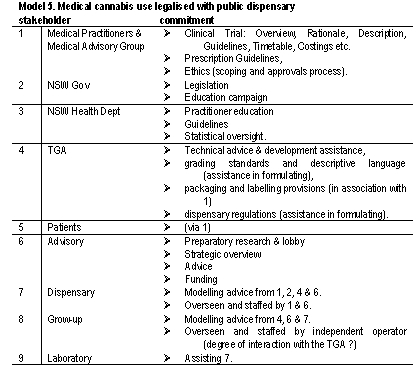
Models 3, 4, & 5. Medical prescription with public dispensary (trials) or Public dispensary (legal medical cannabis only model).
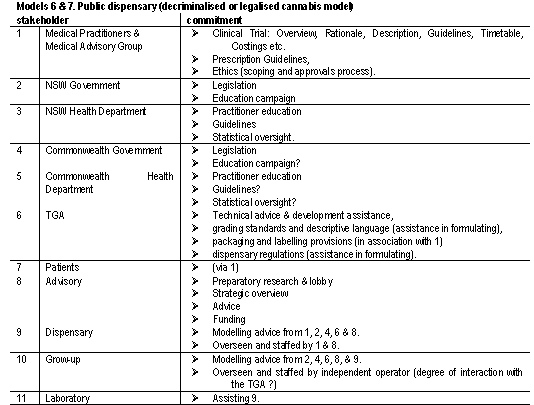
Models 6 & 7 Public dispensary (decriminalised or legalised cannabis model)
OTHER CONSIDERATION
Where might a dispensary be set up?
How large should a trial dispensary be?
Who should be the target clientele?
Appendix 1. Possible cannabis dispensary enabling legislation.
Appendix 2. Extracts from: Crimes (Traffic in Narcotic Drugs and Psychotropic Substances) Act 1990.
Introduction
Using medical cannabis as an aid in the relief of suffering does not appear to be a contentious medical or social issue in our country. Why? There is no evidence of there having been an ongoing, widespread, mainstream debate inside Australia regarding the use of cannabis as a therapeutic agent.
Yes, there are countercultural groupings that have always celebrated the use of cannabis in all its forms, and continue to do so, and there are also sophisticated medical and therapeutic communities where the idea of using cannabis has always been considered unremarkable; but these are discreet or elite groups. They have little or only intermittent intersection with the mainstream of our contemporary discourse.
So why the huge shift in public perception? Twenty years ago Cannabis was a killer weed. Two decades on things are very different.
Cannabis is now widely accepted as a medicine. In the case of palliative care the orthodox view is that cannabis should be made available. And this shift in social consciousness seems to have occurred more despite, rather than because of, any great degree of active debate in our parliaments, our newspapers, or other mainstream media outlets.
So why do most Australians now agree that cannabis should be made available to patients where prescribed by an authorised medical practitioner? Why the dawning, but seemingly widespread, acceptance of the use of cannabis as a therapeutic agent?
Surely this new, common-sense, appreciation, has bled into our contemporary consciousness as a result of our close integration in the global media-marketplace.
Australians, even behind the Great Wall of Howard, have apparently absorbed many of the everyday attitudes that now shape the citizenry of California and Oregon. After all, their narratives are our narratives (think: Law & Order, CSI, MASH, The Beverly Hillbillies, Scooby-Doo, Ice Truckers, 60 Minutes, The Simpsons).
A clear comprehension of this cross-cultural dynamic is essential to charting
a course forward. Our Australian common-sense about medical cannabis has been
vicariously transformed over the years by our constant exposure to stories emanating
directly from the heart of middle-America, stories carrying everyday middle-American attitudes along with them. We have been transformed by the US and Canadian experience and their ongoing social and legal upheavals. And of course this provides for opportunities and difficulties.
Australians (largely) share the same views regarding medical cannabis that substantiate the common-sense in places where thousands of cannabis dispensaries currently meet a vital social need in a responsible manner. Medical cannabis dispensaries are a fact of life in virtually every other first world country.
Why not in Australia?
The Great Wall of Howard has fallen - but during the years of our isolation the political and legal institutions of our land have fallen way behind the common-sense and will of the people. Our legal and political structures appear frozen in aspic. There are no dispensaries. Patients are left out in the cold. Politicians neglect their constituency.
Let’s change our law to bring it into line with the will of the majority.
Cannabis as a Therapeutic Agent
Therapeutic uses for cannabis
A brief review of the literature indicates that medical cannabis has been shown to have established beneficial effects in the treatment of nausea, vomiting, premenstrual syndrome, unintentional weight loss & lack of appetite, spasticity, neurogenic pain & movement disorders, asthma, glaucoma, inflammatory bowel disease (Crohn’s disease / ulcerative colitis), migraine, fibromyalgia, multiple sclerosis, & spinal cord injuries,
Clinical trials provide evidence that THC may reduce the motor and vocal tics of Tourette syndrome and related behavioural problems such as obsessive–compulsive disorders. The drug also exhibits antispasmodic and muscle-relaxant properties.
Other studies have shown cannabis or cannabinoids useful in treating alcohol abuse, attention-deficit hyperactivity disorder (ADHD or AD/HD), amyotrophic lateral sclerosis, collagen-induced arthritis, rheumatoid arthritis, asthma, atherosclerosis, autism, bipolar disorder, childhood mental disorders, colorectal cancer, depression, diabetic retinopathy, dystonia, epilepsy, digestive diseases, gliomas, hepatitis C, Huntington’s disease, hypertension, urinary incontinence, leukaemia, skin tumours, morning sickness, methicillin-resistant Staphylococcus aureus (MRSA), Parkinson’s disease, pruritus, posttraumatic stress disorder (PTSD), sickle-cell disease, and sleep apnoea.
The NSW Parliamentary Library Research Service has listed the claimed therapeutic effects of cannabinoids to include:
the control of nausea/vomiting associated with cancer chemotherapy;
the control of muscle spasticity (eg, associated with multiple sclerosis, cerebral palsy and spinal chord injuries);
pain management (eg. analgesic, anti-inflammatory);
anti-convulsant effects (eg. epilepsy);
treatment of glaucoma; and
bronchodilation (asthma treatment).
They also listed claimed harmful effects including:
effects on memory, learning and cognition, and higher order cognitive processes;
short-term cardio-vascular effects;
long-term risks of bronchial disease and cancers of the aerodigestive tract;
links with psychotic conditions such as schizophrenia in vulnerable individuals;
dependency - cannabis fulfils the modern (psychologically based) criteria for a drug
dependency; and
effects on the immune and reproductive systems.
Relative Harm
The classification (‘relative harm’) debate currently underway in the UK relates to where in the scale of dangerous drugs cannabis should be listed. Professor David Nutt has recently asked, ‘if the relative harms caused by all recreational drugs used in our society are compared and contrasted rationally, just where on such a scale does cannabis fall?’ His provision alanswer to this pertinent question is provided (see figure 1).
The UK debate is indicative of an international trend towards reassessing many of the assumptions relating to toxicity and possible consequential damage that prompted the imposition of a general worldwide prohibition on the use of cannabis as a recreational drug. This trend has profound implications for those who are lobbying on behalf of using cannabis as a medicinal agent.
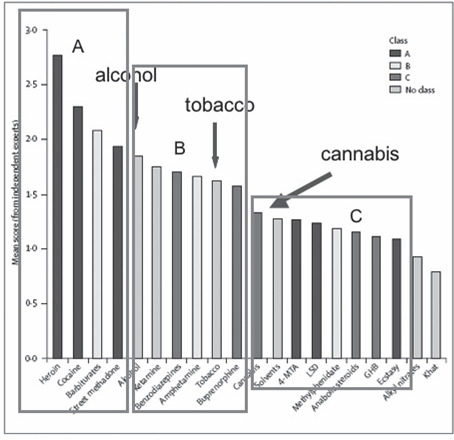
Figure 1. Mean harm scores for 20 substances.
The respective classification under the Misuse of Drugs Act (UK), where appropriate, is shown above each bar. Class A drugs are indicated by black bars, B by dark grey, and C by light grey. Unclassified substances are shown as unfilled bars.
Unlike most newer therapeutic agents, and the vast majority of pharmaceuticals currently prescribed by doctors in Australia, cannabis has little potential to cause any lasting physical harm. There have been no fatalities from toxic overdose recorded (ever).
Assessing the gap between a therapeutic dose and a lethality threshold for medicinal cannabis is somewhat problematic. For barbiturates a lethality threshold can be reached within a 3 to 5 x therapeutic dosage range. For cannabis this must be a multiple in the hundreds (if not thousands; if physically achievable).
When possible contraindications arising from the use of cannabis as a therapeutic agent are balanced against probable short-term beneficial effects (rather than just the possibly nebulous benefits of intoxication) the equation becomes a simple, lopsided, affair. Cannabis cannot be considered a potentially toxic agent. There are no acute toxicity issues in play regarding cannabis, only general issues relating to intoxication, the very same intoxication issues that attend many other therapeutic agents that are in current daily use, and almost all, potentially far more toxic than cannabis.
Medical Cannabis around the world.
In 2008, Austria the Parliament approved cannabis cultivation for scientific and medical uses. Cannabis cultivation is controlled by the Austrian Agency for Health and Food Safety (Österreichische Agentur für Gesundheit und Ernährungssicherheit, AGES)
In the Czech Republic Adult citizens can legally use, possess, and grow small quantities of cannabis.
In Germany the possession of small amounts of marijuana/hashish was ruled legal by the German Federal Constitutional Court in 1994.
In the Netherlands the sale of Cannabis in Coffee Shops has been long tolerated, to the point where the drug has attained a de facto decriminalisation.
‘Health Canada’ permits marijuana for approved patients who can demonstrate a medical need for it.
In the United States of America, 13 states have legalized medical marijuana. In Alaska, California, Colorado, Hawaii, Maine, Michigan, Montana, Nevada, New Mexico, Oregon, Rhode Island, Vermont and Washington, and Maryland reduced or no penalties apply if cannabis use has a medical basis.
In the UK: The position in practice … is that cannabis and most of its derivatives may not be used in medicine, and may be possessed for research only under Home Office licence. According to the House of Lords Select Committee report, only two psychoactive cannabinoids, nabilone and dronabinol, may be used for medical purposes. Moreover, two non-psychoactive cannabinoids - cannabidiol and cannabichromene - are not controlled drugs and could, in theory, be prescribed as unlicensed medicines. However, it appears that no one is currently doing so.
Therapeutic Cannabis trials in Australia
In May of 2003 the Premier of NSW, Bob Carr, announced that NSW would be the first state in Australia to introduce a trial of Medical Marihuana. Simon Crean, then Federal Opposition leader, backed the proposal.
“As a human society we’ve got to have regard for the suffering of the patient and if it is based on the medical evidence as Bob suggests, then I think it’s the right call,” Mr Crean said.
When the NSW trial failed to materialise nobody associated with the Drug Law Reform community in Australia was surprised. Nor were they particularly surprised to find that when the Federal Opposition took the reigns of power that they also seemed to forget all about their once positive regard for the use of cannabis as a medicinal agent.
Cannabis Pharmacopeia- source stock
An agreed scale of variation and grading?
In the UK there is no state/federal divide, so there is no corresponding need to worry about overly ambitious state legislation being slapped down as being unconstitutional. There is also, effectively, only one level of government that needs to be convinced of a need for change. Perhaps this is why the debate in the UK seems to have moved a little further than it has in Australia?
At least there has been some discussion about particular methodologies of prescription (or recommendation) that might be used regarding medical cannabis. There has also been some quantitative work undertaken in sampling seizures of cannabis and in trying to correlate the type and potency of the seized drugs with the stated intent of the user (ie – recreational / medical). It is this quantitative data that is of immediate interest.
Executive Summary from the HOME OFFICE CANNABIS POTENCY STUDY 2008:
This study was funded by the Home Office. It arose from a recommendation in the 2006 Cannabis report of the Advisory Council on the Misuse of Drugs (ACMD).
The proportion of herbal cannabis has increased markedly in recent years.
In 2002 it was estimated that it represented around 30% of police seizures of cannabis, but by 2004/5 had reached 55%.
Twenty-three Police Forces in England and Wales participated in the study.
Forces were requested to submit samples confiscated from street-level users.
In early 2008, they submitted 2,921 samples for analysis to either the Forensic Science Service Ltd (FSS) or LGC Forensics at Culham (LGCF).
Initial laboratory examination showed that 80.8% were herbal cannabis and 15.3% were cannabis resin. The remaining 3.9% were either indeterminate or not cannabis.
Microscopic examination of around two-thirds of the samples showed that over 97% of the herbal cannabis had been grown by intensive methods (sinsemilla).
The remainder was classed as traditional imported herbal cannabis.
Regional variations were found in the market share of herbal cannabis. Thus North Wales, South Wales, Cleveland and Devon and Cornwall submitted proportionately fewer herbal cannabis samples, whereas Essex, Metropolitan and Avon and Somerset submitted proportionately more. These differences were statistically significant at the 0.1% confidence interval.
The mean THC concentration (potency) of the sinsemilla samples was 16.2% (range = 4.1 to 46%). The median potency was 15.0%, close to values reported by others in the past few years.
The mean THC concentration (potency) of the traditional imported herbal cannabis samples was 8.4% (range = 0.3 to 22%); median = 9.0%. Only a very small number of samples were received and analysed.
The mean potency of cannabis resin was 5.9% (range = 1.3 to 27.8%). The median = 5.0% was typical of values reported by others over many years.
Cannabis resin had a mean CBD content of 3.5% (range = 0.1 to 7.3%), but the CBD content of herbal cannabis was less than 0.1% in nearly all cases.
There was a weak, but statistically-significant, correlation (r = 0.48; N = 112; P < 0.001) between the THC and the CBD content of resin.
A similar wide variation in THC/CBD intensities and proportions has been detected in the US:
Upon analysis by GCMS, the potency of the 42 sinsemilla samples was determined to range from 10.2% to 31.6% THC, with a mean of 19.4%. These results were surprisingly high, given that the average potency of marijuana in the U.S. has been typically estimated at around 3% to 4% by NIDA, with higher grade sinsemilla ranging towards 10% - 15%. The highest potency recorded came from a sample of hashish, which registered 68.6%. Yet even a sample of Mexican commercial grade registered a surprisingly high 11%, twice what we had expected. All of this cast a troubling shadow of doubt on our test results, although it appeared likely that we were dealing with highly potent varieties. …
In contrast, the CBD levels observed were surprisingly low. Only four of the sinsemilla samples had more than 0.3% CBD, and 35 of them had only trace amounts (<0.1%). However, one sample had an astoundingly high CBD content of 28.0% (plus 11.6% THC). Another registered 5.6% CBD and 13.4% THC. …
As for CBN, the majority of samples showed only trace amounts. The highest level detected was 1.4%, and only one other sample tested above 1%. CBN is a breakdown product of THC, so high CBN levels are expected in old, degraded samples.
Implications for Australia
A review of the models currently in use in other locales does not provide for an uncomplicated list of statutes, codes, and charts amenable to any sort of easy translation to suit Australian conditions.
Scientific work in overseas jurisdictions points to a need to not only encompass considerations relating to THC potency, but also levels of CBD and the relative age of the plants used as source materials (via CBN), also several more amorphous factors such as ‘harshness’ and ‘aroma’.
Requisite technical processes and methodological abilities are available, here, within NSW. What is not available is an agreed upon scale of variation and grading, formulated in a manner sufficient to meet the requirements of the Australian therapeutic goods environment.
The Therapeutic Goods Administration has detailed requirements regarding the sourcing, grading, processing, purity, weight, packaging, and documentation relating to all medicinal substances that might be distributed in our country.
Most of these requirements can easily be met with medicinal cannabis. What is lacking are descriptive and definitive classifications enabling the sorting of various grades of cannabis relative to precise prescriptive directions.
A wide variability in the source stock available for medicinal cannabis production is probable (going by overseas experience) but this is something that can be suitably controlled for if careful attention is paid to all the potential variations that might be of import in the generation of an applicable Australian Standard for medical cannabis (and thence associated regulations governing the dispensing of the drug).
In an Australian Standard the THC and CBD levels need to be located within a preferred potential therapeutic range. Testing for CBN is indicated as a control for old or overly mature stock. Also a subjective assessment of the quality of the source stock (aroma/harshness) should be incorporated. Table 1 provides a representation of one possible grading scale.

Such a scale might also act as a heuristic agent for medical services practitioners, enabling particular therapeutic indications to be matched to a corresponding appropriate grade of medicinal cannabis.
The US Government.
In some instances cannabis is still provided directly to a very few U.S. patients from stocks produced by the federal government in government run facilities. However, in the main, cooperative groups, or individuals, sell cannabis to municipally licensed cannabis dispensaries, according to guidelines largely formulated by the dispensary movement itself (with guidelines mainly describing ‘types’ rather than prescribing grade specifications that measure specific alkaloid groupings).
The Compassionate Use Act of 1996 (Health & Saf. Code, § 11362.5) (marijuana for medical purposes) governs the medical cannabis sector in California.
The Californian dispensary model is often cited in Australian literature because of a perceived similarity of medical methodologies across the two countries.
However there are also a great many dissimilarities. This model is also often cited as representing current best-practice, however for each of its oft quoted benefits there are also potential countervailing arguments. Perhaps even the Americans haven’t got it all sorted out yet? Consider this recent commentary from Esquire (October 2009).
Two years ago, in the throes of a Bush administration that disregarded states’ rights whenever it felt like getting high on itself, there were fewer than two hundred medical-marijuana outlets in Los Angeles. Today, even the most conservative estimates say that number has quadrupled. On one stretch of Santa Monica Boulevard alone, four thriving pot shops estimate their tax payments at $4 million a year. Got an emergency radiation treatment and can’t find the nearest store? There’s an iPhone app for that.
With patient demand pushing dispensaries in several of the fourteen states that allow medical marijuana to expand their business, the Obama administration last week ordered the Justice Department to respect state laws and stop harassing
them.
You would think, after our new president’s ups and downs on what is ultimately the road to wholesale legalization, that calling off the pot bullies would be, by all accounts, A Good Thing. Hundreds of thousands — if not millions— of Americans have used the approved stuff, after all, whether as therapeutic medicine or therapeutic something else.
Trouble is, all this common sense seems to have fried the brains of the law-enforcement leaders in the City of Los Angeles. They’ve suddenly come up with a bizarre new interpretation of the law — that the requirement for pot dispensaries to be “nonprofit” actually means that they can’t accept cash.
Yes, you read that right. This is how Deputy City Attorney David Berger put it: “We can still use state law to enforce, and we still believe that
the only legal way to do that is to enforce against the selling of marijuana, as opposed to giving it away as a collective.”
This has to be the first time in American history that the government is ordering its citizens to start collectivizing our farms.
The backwards logic was codified in the fourth version of a draft ordinance that City Attorney Carmen Trutanich submitted last Tuesday to the Los Angeles city council. Apparently a hard-core member of the Marxist-Leninist wing of the Republican party, Trutanich even argued that dispensary owners shouldn’t use cash to pay for labor or fertilizer — that the voters of California actually intended for marijuana to be produced and dispensed, unlike all other drugs in the known universe, on a pure barter system. (This from the man who made Michael Jackson’s funeral look like it switched from the Staples Center to Tammany Hall.)
Naturally, the government’s marijuana bait-and-switch over the past eight days has producers and dispensers very upset. When I spoke with her late last week, Yamileth Bolanos, owner of a shop called PureLife Alternatives and president of an influential medical-marijuana trade group, summed up the general sentiment:
“They expect people who are sick and on chemotherapy to get up and farm their own crop? If you’re not directly involved in growing the crop, you can’t have any of it?”
Imagine the unintended consequences, Bolanos said. “They say there’s between 250,000 and 300,000 medical marijuana patients in the city of Los Angeles, and we don’t have wide-open spaces here where we can grow. That means every building in Los Angeles will be a grow site.”
The draft ordinance is city’s latest attempt to bring some kind of order to the explosion of pot stores, all of which have so far failed. Bolanos insists that she and the marijuana community want to be partners in this, helping to clean up the shady cannabis clubs that don’t pay taxes or check prescriptions.
“We’ve been screaming for regulation,” she told me. “I’ve gone to the city council and said, ‘Show us the rules. Tell us what to do, so we
can provide for patients in a safe manner.’ [But] the city let the situation get out of hand — they wouldn’t give us regulations, so we made up our
own regulations, we started accrediting clubs. We follow the rules very strictly, but what they’re asking us to do now is impossible.”
In framing guidelines for dispensaries to operate in Australia we have an opportunity to learn from the mistakes of others.
The black market can never be a satisfactory source for medical cannabis stocks for a number of reasons, illegality aside. The black market product will always be expensive. And the need to produce a continuous supply of material meeting particular grade and type requirements is unlikely to be fulfilled.
The ‘grow-up’ practice.
Cannabis cultivation for therapeutic purposes imposes added impositions upon a grower that must be addressed. In most countries where the practice is legal the best-practice cultivation of medical marihuana occurs under lights in a controlled environment. This may or may not be appropriate in Australia but we can mimic some of the more successful aspects of overseas practice to our advantage.
Known strains providing consistent purity and potency profiles should be developed, maintained, and intermittently tested. To maintain consistency the majority of Californian ‘grow-ups’ propagate and grow-on only plants cloned from known and assessed parent stock.
The setting up of a grow-up facility is an exceptionally complex task. There are a number of indications that the concurrent establishment of a grow-up, alongside a dispensary service, would be the best route to follow. This will obviate many potential criticisms of the dispensary service relating to the black market as well as providing reliable and definable potency profiles for any cannabis that might be dispensed.
Such an operation cannot be supplying both the legal and black markets. Therefore a grow-up for this project will not only be expensive but will also require premises that are not only legally suitable (re zoning) but also anonymous and secure. An urban site zoned for light commercial activity or a rural site zoned for agricultural pursuits is probably the most appropriate site for a grow-up in Australia. The production of cannabis for a dispensary trial in well documented and strictly controlled conditions is a required aspect of a dispensary trial.
Probable criticisms (relating to support of black market activities etc) will be more easily overcome if the site is well run and maintained and low-key.
Such an operation must be overseen by someone of impeccable legal and commercial reputation. The person operating a grow-up is as likely to be arrested and charged as any other of the participants in this project, however the nature of the charges that might be leveled against the operator of the grow-up are significantly more severe than those likely to be visited upon others.
Pharmacopeia practice.
It is essential that any Dispensary (trial or otherwise) only provide cannabis to those particular patients meeting the precise requirements dictated as sufficient to obtain a prescription. Prescription verification procedures must be mandatory and defined in regulation. Any leakage or illegal provision of cannabis to non-patients will act to discredit the dispensary model and will undoubtedly be counterproductive in a number of ways.
All cannabis stocked within a Dispensary Pharmacopoeia must be of a defined strength (potency), type (strain), and weight. Every gram must be traceable directly, via a paper trail, back to the grow-up process. This paper trail must be plainly reviewable and amenable to audit.
Procedures, regulations, and rules, overseeing Dispensary operations should be formulated in association with medical advice and this process largely guided by the best-practice of institutions currently operating dispensaries in California and Canada.
In some instances the Californian experience might prove to be the best guide (relating to the institutional practices of dispensary and grow-up) whereas other aspects of the project might be better off looking to the Canadian experience (regarding the integration of the project within the established medical environment in Australia).
Best practice?
No entirely successful models for meeting the needs of providing source stock for cannabis pharmacopeia seem to exist, however some simple observations might be made:
Dispensaries must be able to licence individuals or corporations to grow cannabis source stock for their pharmacopeia.
Dispensaries must be barred from participating in the black market.
TGA regulations should be formulated regarding the process of dispensing medicinal cannabis.
TGA guidelines should be formulated regarding the testing and grading of medicinal cannabis.
The TGA should formulate Australian Standards regulating and defining grades of medicinal cannabis.
Medical authorities should formulate prescription / recommendation methodologies utilising Australian Standards that define grades of medicinal cannabis (and their associated therapeutic attributes).
Any medical cannabis regime in Australia must encompass a legal facility for patients to grow their own cannabis at home.
Provision must be made to assist patients in assessing and quantifying the potency and characteristics of cannabis produced at home.
Legislative & related considerations
We are granted the benefit of overseas experience. Australians are provided the possibility of doing things differently. We can act to proactively manage a transition to using medical cannabis as a mainstream product in an orderly and rational manner. We can learn from the mistakes of others.
Can cannabis be designated as a therapeutic agent by a state government? Prima facie, anyone trafficking or distributing cannabis in a dispensary situation, even following amending legislation at a state level, may be in breach of the Crimes (Traffic In Narcotic Drugs and Psychotropic Substances) Act 1990 et al (Cth), however any such prosecution (regarding validity) would probably arise from third party rather than government interests; it is judged unlikely than a Labor Administration would challenge a Labor Administration regarding this issue. In fact, following a comprehensive review of the (state government level) amendments (as proposed at 46A in Appendix 1) it might be hoped that a federal Labor administration might pass complimentary legislation clarifying the several possible legal ambiguities that are apparent
The Great Wall of Howard shadowed Australia from many developments in the wider world but this dark period in our past has only acted to retard and postpone the inevitable. We have already been civilly inoculated to the concept of cannabis as medicine via our constant digestion of mainstream media products originating in the US and the same need that prompted the overseas experience is evident here; so doing nothing is simply a recipe for civil dissention.
Medical cannabis is coming to a dispensary near you. It will happen, and it will happen sooner than you thought it might.
In the Americas the transition through illegality to tolerance, to industry sector, has already occurred. In Mexico cannabis is legal. In Canada medical cannabis is widely (differentially relating to province) available and the debate is current in the civil discourse. In 14 of the US States medical use is either entirely or substantially a defence, or is entirely legally sanctioned. Australia is an outlier. Most of our first world contemporaries have long since been engaged in the medical cannabis debate.
This overseas experience will prompt a home-grown response.
The Green Rush will arrive in Australia.
Any rational appraisal of overseas experience indicates:
a) that there are few successful models available from which to choose,
&
b) that we will have to choose. And soon.
Australian Law - general.
Australian law enforcement, in the main, regards all cannabis as being for recreational use. There are provisions within several statutes across the country indicating some legislatures have presupposed that cannabis may have medicinal value (such as in the Drugs Misuse and Trafficking Act in NSW) but there are no institutional or regulatory provisions in place, anywhere in the country, which might allow for the legal cultivation (or obtaining of) cannabis for use as a medicine.
A cannabis dispensary may breach at least several NSW State laws. Possession of cannabis, possession of a quantity of cannabis deemed for sale, and conspiracy charges, etc, are all possible under the current legal framework – regardless of the stipulated or actual intent of the parties running a dispensary.
Depending on the particular manner of business conduct and policy directives provided the Police, a dispensary may also be found to breach Commonwealth Laws.
An extensive legal brief should be proactively compiled if Model 3/4 is implemented without amending legislation having been passed at the State level (model 5).
The TGA
Guidelines relating to dosage, contraindications, and production, potency, and purity of prescription medications are all under the purview of the Therapeutic Goods Administration. No prescription medicine can be sold in Australia unless it conforms to rules formulated by the TGA. According to the TGA ‘cannabis’ (as variously listed under Schedule 1 of the Drugs Misuse and Trafficking Act NSW) cannot be considered as a therapeutic agent. Medical cannabis trials and/or dispensary trials could proceed under TGA statutes and guidelines as currently formulated. This would be dependent on policy inclination – not existing institutional, regulatory, or statutory inhibitions.
Constitutional Law.
There are a number of particular tests used to adjudge whether or not a State Act (as proposed in Appendix 1 of this volume) might be valid.
A federal court will initially determine:
Is the law validly enacted?
Has the law a sufficient nexus with the State?
Does the law relate to an exclusive Commonwealth power?
The only exclusive Commonwealth power enumerated that might create for difficulties is quoted below. Section 51 (xiiiA) could be argued to relate to the provision of medical service or consideration in the broad and so defining an exclusive federal province. However, this placitum has always been considered in relationship to the provision of pensions and is likely to be read down. If there were a particular federal act relating to (either regulating or prohibiting) medical cannabis then this placitum might be used to point to an exclusive Commonwealth power.
From the Australian Constitution:
51 Legislative powers of the Parliament
The Parliament shall, subject to this Constitution, have power to make laws
for the peace, order, and good government of the Commonwealth with respect to:
…
(xiii) invalid and old-age pensions;
(xiiiA) the provision of maternity allowances, widows’ pensions, child
endowment, unemployment, pharmaceutical, sickness and hospital benefits, medical
and dental services (but not so as to authorize any form of civil conscription),
benefits to students and family allowances… [my emphasis].
Section 109
Section 109 of the Constitution provides that where ‘a law of a State
is inconsistent with a law of the Commonwealth, the latter shall prevail, and
the former shall, to the extent of the inconsistency, be invalid’.
Traditionally three forms of inconsistency are considered (Telstra Corp Ltd
v Worthing):
A - Direct inconsistency: or where mutually contradictory commands make it impossible
to obey both sets of law.
There are a number of different alternatives which this may occur.
a) Where one law permits or commands, and the other forbids
(i) Government Activity. Daniell.
(ii) Prohibition on Citizens. Colvin v Bradley Bros
(iii) Commonwealth law specifically invalidates certain type of state law. Mabo
v Queensland (No1) re Commonwealth Racial Discrimination Act 1975.
(iv) Commonwealth Body not subject to state law. Telstra Corporation Ltd v Worthing.
b) Or both laws forbid the activity, but have different penalties, classes of
crime etc
(i) Negligent navigation of a ship causing collisions. Hume v Palmer
(ii) Damages to Commonwealth Property. R v. Loewenthal.
(iii) Offences under Victorian Evidence Act. R v Winnecke; Ex parte Gallagher.
(iv) Driving under the influence. McWaters v Day.
B - Rights inconsistency: Where one law confers a right or privilege, the other
takes it away or modifies it
a) State law prescribes higher conditions then Commonwealth Law
(i) Industrial Awards. Clyde Engineering v Cowburn; Blackley v Devondale Cream
(Barwick CJ at 258 held that once the Commonwealth has conferred this right,
the State cannot take it away, or modify it.)
b) Commonwealth law simply prohibiting something without a license and the State
law also requires a license or permission, but for a different reason –
no inconsistency in these cases
(i) Radio Broadcast. Commercial Radio Coffs Harbour Ltd v Fuller
(ii) Listening Devices. Love v Attorney-General (NSW).
C – Covering the field: If there is a Commonwealth law that intends to
‘cover the field’, any State law that attempts to govern in that
field will be rendered inconsistent.
It is necessary to determine the extent of possible inconsistency as laws may
be similarly complementary (Airlines of NSW).
To determine inconsistency it must be ascertained whether the Commonwealth
law intended to cover or regulate the subject completely and exhaustively (Isaacs
J in Clyde Engineering and Dixon J in Ex pate Mclean).
A 3 step process (Issacs J):
1. Determine the subject matter
2. Determine if the Commonwealth law intended to exhaustively cover the subject
3. Does the state law attempt to cover the same subject?
Legal musings
Type-A inconsistency is arguable. There are no express provisions
relating to medical cannabis in the Crimes (Traffic In Narcotic Drugs and Psychotropic
Substances) Act 1990 (Cth). Other federal statutes visited were also silent
regarding medical cannabis in the particular. Adherence to both sets of statutes
is possible. The possible degree of this conformity describes the scope of any
potential plaint.
The principal argument against a Type-A inconsistency is the existence of language
currently incorporated within the Drugs Misuse and Trafficking Act (NSW) describing
‘a prohibited drug lawfully prescribed or supplied’. This is not
a new subject or issue at law and a definition between recreational and medical
use is not only possible but actually presupposed by the language of the statute.
An argument regarding type-B inconsistency is unlikely. The proposed legislation
enhances and defines rights in an arena not currently addressed by federal statute.
Type-C inconsistency is unlikely without prior statutory intervention by the
federal government. The determinate subject matter “medical cannabis”
or “medical marijuana” has never been addressed in a federal instrument.
Considering models, stakeholders & legal & regulatory complexity.
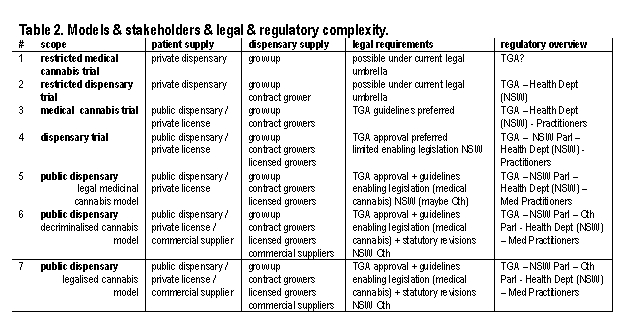
Model 1. A restricted medical trial
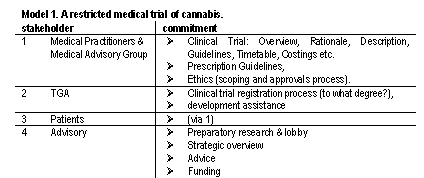
The predominant hurdles facing a restricted trial of this type lie in the policy arena rather than in the facilities of institutions or in limitations imposed by statute.
A restricted medical trial of cannabis (Table 2 #1) in a palliative care situation, conducted under the auspices of the TGA, and using materials produced in a restricted single instance grow-up via a private dispensary (utilizing one time guidelines formulated in association with the TGA) – may be legal. (It certainly is warranted.)
Under s 10 (et al) of the NSW Drugs Misuse and Trafficking Act 1985 provision has been made for the administration, self administration, possession, and possession of implements related to cannabis that is possessed and used in accordance with a valid prescription.
(1) A person who has a prohibited drug in his or her possession is guilty of an offence.
(2) Nothing in this section renders unlawful the possession of a prohibited drug by: …
(d) a person who:
(i) has the care of, or is assisting in the care of, another person for or to
whom the prohibited drug has been lawfully prescribed or supplied, and
(ii) has the prohibited drug in his or her possession for the sole purpose of
administering, or assisting in the self-administration of, the prohibited drug
to the other person in accordance with the prescription or supply.
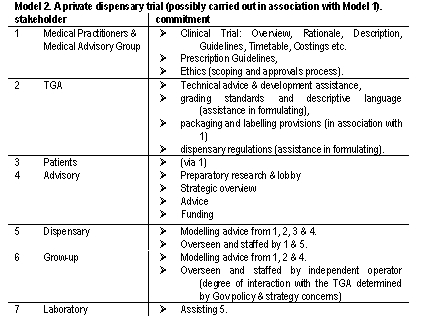
Model 2. Restricted dispensary trial
A private dispensary trial carried out in association with Model 1 may also be legal. Such a service may not be strictly required but initiating a template dispensary process is highly desirable, even if only a private dispensary supplying a restricted patient list for a specified duration.
Medical guidelines for a dispensary are essential. The California Medical Association has developed extensive literature and any Australian dispensary project should seek assistance from sympathetic medical practitioners in Australia in reformulating a compilation of this material in a manner more suited to an Australian audience.
Models 3, 4, & 5. Medical prescription with public dispensary (trials) or Public dispensary (legal medical cannabis only model).
This model envisages the outright decriminalisation of medical cannabis (only) use in NSW or trials towards decriminalisation.
Dispensary activities under model 5 envisage enabling legislation having been passed in NSW. A series of simple amendments to the Drugs Misuse and Trafficking Act 1985 would suffice (see appendix 1).
The NSW parliament could legislate to decriminalise the use of cannabis as a therapeutic agent without the law being struck down in a federal court as being unconstitutional. Provisions strictly confined to the medical use of cannabis would likely be within the remaining purview of state power and there appear to be no current federal statutes covering this field.
Models 6 & 7 Public dispensary (decriminalised or legalised cannabis model)
No State in Australia can unilaterally decriminalise or legalise the recreational use of cannabis without these laws being immediately open to challenge. Such a challenge, on the multiple grounds of incompatibility, inconsistency, and ‘covering the field’, would certainly succeed.
For models 6 or 7 to be implemented the Commonwealth Government has to be a primary stakeholder in the process.
Other considerations.
Where might a dispensary be set up?
There are aspects of the project which lend themselves to setting up a dispensary within the Nimbin township:
Community support.
Close to the project’s home base (Nimbin).
Ease of recruiting staff.
Ease of recruiting expertise.
The centrality of Nimbin to Cannabis Culture in Australia.
Known contacts in the municipal arena.
There are also aspects which mitigate against setting up a dispensary within the Nimbin township:
The centrality of Nimbin to the Hippie/Alternate cultures of the region and country.
The possibility of the trial being seen as ‘another Nimbin thing’
The potential for misappropriation or leakage of stock is increased.
Patients requiring palliative care (the easiest clientele to’sell’) might be limited in this region.
The Dispensary is more likely to be considered a ‘stunt’.
How large should a trial dispensary be?
Any dispensary project will encounter problems of scale right from the outset.
The larger the trial the easier it will be to make such an undertaking financially
neutral. However the larger the trial the more difficulties will be encountered
in restricting the clientele to those particularly indicated by medical authorities
as viable patients.
Perhaps the dispensary should be set up as a mobile outfit so as to enable the
dispensing of medical marihuana in a number of urban settings within the region?
Such a course of action would enable the project to access the many palliative
care patients in places like Ballina whilst also catering to the residents of
Byron, Lismore, Kyogle etc.
Who should be the target clientele?
As already indicated the easiest patient type to ‘sell’ to the public
at large is the palliative care segment of the population. Very few of those
queried, even if they had reservations about the other patient types, felt any
reservations at all in supplying cannabis to those who are in the terminal stages
of life threatening diseases.
Any Dispensary trial would be advised to adopt as great a patient load from
the palliative care segment of the patient population as might be possible.
Appendix
Appendix 1. Possible cannabis dispensary enabling legislation.
Drugs Misuse and Trafficking Act (New South Wales) Amendment (Medicinal Cannabis)
Act 2010.
1 Name of Act
This Act is the Drugs Misuse and Trafficking Act (New South Wales) Amendment
(Medicinal Cannabis) Act 2010.
2 Commencement
This Act commences on a day or days to be appointed by proclamation.
3 Amendment of the Drugs Misuse and Trafficking Act 1985 No 8.
The Drugs Misuse and Trafficking Act 1985 No 8 is amended as set out in Schedule
1.
Schedule 1. Amendments of Drugs Misuse and Trafficking Act 1985
[1]
Insert:
8B Definition of “medical cannabis”
(1) Preparations or admixtures containing, in whole or part (as stipulated in
Schedule 1 of this Act):
(a) Cannabis leaf,
(b) Cannabis oil,
(c) Cannabis plant cultivated by enhanced indoor means.
(d) Cannabis plant—other,
(e) Cannabis resin,
If produced, grown, possessed, administered, or self-administered pursuant to
Sections 10 (2) (c) & (d), 11 (2) (e), 12 (2), 13 (3), 14 (2), and subject
to Sections 15, 16, 17, 18 of this Act, shall be deemed “medical cannabis”.
[2]
Insert:
22A Medical Cannabis
(1) Subject to the provisions of Section 8B (1) nothing in this Act renders
unlawful the holder of a valid prescription for medical cannabis:
(a) cultivating or taking part in cultivating, medicinal cannabis, or
(b) manufacturing or producing, or taking part in manufacturing or producing,
medical cannabis, or
(c) possessing medical cannabis mixtures, admixtures or preparations.
[3]
Insert:
Part 5 – Cannabis Dispensaries.
Division 1 - Preliminary.
46A Operation of Part 5.
(1) This Part operates to allow the responsible authorities to issue
various licences, in respect of various premises, allowing the holder of said
licence to dispense medical cannabis pursuant to this Act.
(2) Nothing in this Part prevents the responsible authorities:
(a) from issuing a further licence to a person other than the holder
of an earlier licence.
46B Substantiating compliance and legislative review
(1) The responsible authorities may arrange for a review to be conducted
at any time of:
(a) the operations of any cannabis dispensary, and
(b) the provisions of this Part and of any regulations made for
the purposes of this Part,
in order to ascertain whether the provisions of this Part (or any other provisions
of this Act or the regulations) should be amended.
(2) The review is to commence as soon as practicable after the date of
assent to the Drugs Misuse and Trafficking Act (New South Wales) Amendment (Medicinal
Cannabis) Act 2010, and is to be completed by [¬¬¬¬¬¬¬¬¬¬¬¬¬¬¬¬¬¬¬¬¬¬¬__________].
(3) A report of the outcome of the review is to be tabled in each House
of Parliament as soon as practicable after its completion.
46C Prescriptions
(1) Any licensed medical practitioner in NSW shall be authorised to define
and issue a prescription for medical cannabis.
(2) Upon issuing a prescription for medical cannabis notification shall
be made to the NSW Health Department and the details of the prescription shall
be entered into a database compendium.
(3) The NSW Health Department shall provide those holding a licence for
a cannabis dispensary with access to a database compendium listing all currently
valid medical cannabis prescription holders.
(4) The NSW Health Department may authorise and undertake a review at
any time into the prescribing of medical cannabis by particular medical practitioners.
(5) Following a validly conducted review pursuant to subsection (4) the
NSW Health Department may refuse to endorse particular defined medical cannabis
prescriptions.
46D Definitions
In this Part:
“cannabis dispensary” means the premises that are
the subject of a cannabis dispensary licence.
“child” means a person who is under the age of 18
years.
“director“, means an individual nominated by the
cannabis dispensary licence holder to be the individual in charge of the licensed
premises.
“internal management protocols“, in relation to
a licensed dispensary, means the protocols finalised for the centre as referred
to in section 46F or, if the protocols are amended or replaced as referred to
in section 46M, the protocols as so amended or replaced.
“law” includes common law.
“licence” means a licence in force under this Part.
“prescribed drug” under this Part means medical
cannabis as stipulated in 8B of this Act.
“qualified health professional” means a medical
practitioner, or a person having qualifications or experience specified or described
by order of the Minister published in the Gazette.
“responsible authorities” means the Commissioner
of Police and the Director-General of the Department of Health.
“staff“, in relation to a cannabis dispensary, includes:
(a) all persons engaged to provide services at the centre, whether under
a contract of employment or otherwise, and
(b) all persons authorised to provide voluntary assistance at the centre
in accordance with the centre’s licence conditions and internal management protocols.
The employer of a person referred to in paragraph (a) or (b) is the person by
or on whose behalf the person so referred to is engaged to provide services
or authorised to provide voluntary assistance, as the case requires.
“supervisor”, in relation to a cannabis dispensary, means the director
of the centre or another individual nominated by the director to supervise the
centre.
Division 2 – Dispensary licences.
46E Licences
(1) The responsible authorities may issue a licence authorising the holder
of the licence to conduct activities specified within this Part as a cannabis
dispensary.
(2) Nothing in this Part entitles a person to be issued with a licence,
and the responsible authorities may refuse an application for any reason listed
within this Part, or for any other reason.
46F Restrictions on issue of licence
(1) A licence for the conduct of premises as a cannabis dispensary must not
be issued unless the responsible authorities are of the opinion:
(a) that the internal management protocols for the proposed centre have
been finalised and are of a satisfactory standard, and
(b) that there is a sufficient level of acceptance, at community and
local government level, for the establishment of a cannabis dispensary at the
premises, and
(c) that the premises are suitable for use as a cannabis dispensary,
having regard to all relevant matters including the following:
(i) public health and safety,
(ii) the visibility of the premises from the street,
(iii) the proximity of the premises to schools, child care centres
and community centres,
(iv) any matters prescribed by the regulations for the purposes
of this section.
(2) If a community drug action plan is in force in relation to the area within
which the premises of the proposed cannabis dispensary are situated, the responsible
authorities must have regard to that plan in forming an opinion as to the matters
referred to in subsection (1) (b) and (c).
(3) Without limiting subsection (1), a licence for the conduct of premises as
a cannabis dispensary must not be issued unless the responsible authorities
are of the opinion:
(a) that any building work that is carried out for the purposes of the
centre will be carried out in accordance with the Building Code of Australia,
and
(b) that any building that is used for the purposes of the centre will
comply with the Building Code of Australia.
(4) In subsection (3), “building”, “Building Code of Australia”
and “building work” have the same meanings as they have in the Environmental
Planning and Assessment Act 1979.
46G Duration of licence
(1) Unless sooner surrendered or revoked, a licence has effect for the
whole of the stipulated period.
(2) The holder of a licence may, after consultation with the responsible
authorities or their representatives, surrender the licence.
46H Conditions of licences generally
(1) A licence is subject to such conditions as may be imposed from time
to time by the responsible authorities, either in the licence or in a separate
order in writing served on the holder of the licence.
(2) Conditions of the kind referred to in subsection (1) may not be imposed
without prior consultation with the holder or proposed holder of the licence.
(3) A licence is also subject to such conditions as are imposed by or
under this Part or the regulations.
46I Statutory conditions of licences
The following provisions are conditions of a licence for a cannabis dispensary:
(a) No child is to be admitted to that part of the centre that is used
for the purpose of the dispensing of prescribed drugs.
(b) The centre’s internal management protocols are to be observed.
46J Contraventions
(1) A contravention of this Division or the regulations in relation to a cannabis
dispensary, or of the licence conditions for a cannabis dispensary, may be dealt
with:
(a) by one or more of the following:
(i) a warning or reprimand administered in writing by the responsible
authorities,
(ii) a fine (not exceeding an amount equal to 50 penalty units) imposed
by the responsible authorities,
(iii) suspension of the licence by the responsible authorities for a
specified period or until further notice, or
(b) by revocation of the licence by the responsible authorities.
(2) If the contravention also gives rise to an offence:
(a) the fact that action has been taken under this section in relation
to the contravention does not prevent a penalty from being imposed for the offence,
and
(b) the fact that a penalty has been imposed for the offence does not
prevent action from being taken under this section in relation to the contravention.
(3) A fine imposed under this section is payable to either responsible authority
within the period specified by the responsible authorities, and is to be paid
into the Consolidated Fund.
(4) If a licensee fails to pay a fine imposed under this section (in whole or
in part), the responsible authorities may suspend or revoke the licence.
(5) Nothing in this section prevents the responsible authorities from amending
or imposing a condition as a consequence of a contravention referred to in subsection
(1).
(6) The responsible authorities are authorised to suspend or revoke a licence
for the purposes of this section.
(7) A contravention referred to in subsection (1):
(a) does not limit the operation of section 46O, except to the extent
that the contravention gives rise to an offence under the regulations made for
the purposes of this Part, and
(b) does not limit the operation of section 46P.
(8) A contravention relating to the admission of a child to a licensed dispensary
is not committed if the licensee establishes that, having regard to the relevant
provisions of the centre’s internal management protocols, it was not apparent
to the centre’s staff that the person concerned was a child.
46K Reviews of licence
(1) The responsible authorities may arrange for the ongoing or periodical
review of any cannabis dispensary.
(2) The responsible authorities must arrange for the review of the economic
viability of a cannabis dispensary if they are satisfied that the service activity
level of the centre has dropped below 75 per cent of the service activity level
prescribed by the regulations.
(3) Regulations referred to in subsection (2) may express the level of
service activity as a specified number of client visits in any period or may
express that level in any other manner.
(4) The responsible authorities may revoke a licence if, after considering
the results of a review under subsection (2), they are of the opinion that the
cannabis dispensary has ceased to be economically viable.
Division 3 – Internal management protocols
46L Matters for consideration in relation to internal management protocols
In considering the internal management protocols for a proposed cannabis dispensary
for the purposes of section 46F, the responsible authorities must have regard
to whether provision needs to be made to ensure that any or all of the following
requirements are met:
(a) The centre must be under the supervision of a supervisor.
(b) The supervisor must have a general oversighting role of the centre’s dispensary
operations and responsibility for ensuring the adequacy of the dispensary procedures
used in the centre. This paragraph does not prevent the supervisor from being
personally involved in dispensary activities in the centre.
(c) All staff directly supervising activities, or undertaking activities, in
the dispensary must undergo a National Criminal History Record Check (NCHRC)
and details of this review must be made available to the NSW Health Department
on demand.
(i) No persons with a criminal history encompassing two (2) convictions
within a period of (10) ten years antecedent to the date of review shall be
employed within a cannabis dispensary.
(ii) No persons with a criminal history encompassing two (2) convictions
within a period of (10) ten years antecedent to the date of review shall be
issued with a licence to operate a cannabis dispensary.
(d) The dispensary must contain or have satisfactory access to:
(i) primary health care referral services, and
(ii) drug and alcohol counselling referral services, and
(iii) drug and alcohol education services.
(e) Procedures are to be established to enable staff to ascertain in appropriate
cases whether a person attempting to fulfil a prescription is a child.
(f) At least one member of staff:
(i) must be a person with satisfactory qualifications or experience in
drug and alcohol counselling, and
(ii) must be in attendance at the centre, or available on call to attend
the dispensary, at all times that it is being used as a dispensary.
(g) The health and safety of staff and users of the centre are to be protected,
having regard to the design and services of the dispensary.
(h) Services are to be available and procedures established to ensure compliance
or ability to comply, at or in connection with the dispensary, with the relevant
requirements of:
(i) this Part, and
(ii) the regulations, and
(iii) the centre’s licence conditions, and
(iv) any other provisions of the centre’s internal management protocols.
(i) Any requirements prescribed by the regulations for the purposes of this
section.
46O Exemption from criminal liability for persons engaged in conduct
of cannabis dispensary.
Despite any other provision of this Act or of any other Act or law (other than
a provision prescribed by the regulations):
(a) it is not unlawful for a person to engage, participate or otherwise
be involved in the conduct of a licensed cannabis dispensary, and
(b) in particular, a person who is engaged, participates or is otherwise
involved in the conduct of a licensed cannabis dispensary does not commit any
offence prescribed by the Act or regulations, just because of that fact.
46P Exemption from civil liability in connection with conduct of licensed
cannabis dispensary
(1) Anything done or omitted to be done in connection with the conduct of a
licensed dispensary does not subject:
(a) the person by whom that thing was done or omitted, or
(b) any other person (including the licensee, the State and any Minister
of the Crown in right of the State),
to any action, liability, claim or demand if the thing was done or omitted to
be done in good faith for the purpose of executing this Part, and was not done
or omitted to be done in a reckless or grossly negligent manner.
(2) This section does not affect any rights or obligations as between a member
of the staff of a licensed dispensary and his or her employer.
Division 5 – Miscellaneous
46Q Application of Environmental Planning and Assessment Act 1979
(1) Development for the purposes of a cannabis dispensary is permissible
without the need for development consent under the Environmental Planning and
Assessment Act 1979.
(2) Part 5 of the Environmental Planning and Assessment Act 1979 does
not apply to or in respect of development for the purposes of a cannabis dispensary.
46R Certificate evidence
In any legal proceedings under this Act, a certificate purporting to be signed
by either of the responsible authorities:
(a) that premises specified in the certificate were or were not, on a
date so specified, a licensed cannabis dispensary, or
(b) that a person specified in the certificate was or was not, on a date
so specified, engaged in the conduct of a licensed cannabis dispensary, or
(c) that a person specified in the certificate was or was not, on a date
so specified, entered on the prescription register as the holder of a valid
medical cannabis prescription,
is prima facie evidence of the fact stated in the certificate without proof
of the signature or of the official character of the person purporting to have
signed the certificate.
46S Regulations
Without limiting section 45, the regulations may make provision, for the purposes
of this Part, for or with respect to any of the following matters:
(a) the standards for a cannabis dispensary, including the elaboration
of internal management protocols for a cannabis dispensary,
(b) the provisions to be observed in the operation of a licensed cannabis
dispensary,
(c) the rules of conduct to be observed by persons using a licensed cannabis
dispensary,
(d) the qualifications of persons engaged in the conduct of a licensed
cannabis dispensary,
(e) the functions of persons engaged in the conduct of a licensed cannabis
dispensary,
(f) the preparation, form and content of a community drug action plan,
(g) the maintenance and amendment of a community drug action plan,
(h) the public and community consultation processes to be undertaken
with respect to the development and review of a community drug action plan.
Appendix 2. Extracts from: Crimes (Traffic in Narcotic
Drugs and Psychotropic Substances) Act 1990.
[Cth] Crimes (Traffic in Narcotic Drugs and Psychotropic Substances) Act 1990
Act No. 97 of 1990 as amended
5 Effect of this Act on other laws
(1) This Act is not intended to exclude or limit the operation of any
other law of the Commonwealth or any law of a State or Territory.
(2) Where a person has been convicted in a country outside Australia
of an offence against the law of that country in respect of any conduct, that
person is not liable to be convicted of an offence against this Act in respect
of that conduct.
6 Meaning of dealing in drugs
(1) For the purposes of this Act, each of the following is a dealing
in drugs:
(a) the cultivation of opium poppy, coca bush or cannabis plant with
the intention of producing narcotic drugs;
(b) the separation of opium, coca leaves, cannabis or cannabis resin
from the plant from which they are obtained;
(c) the manufacture, extraction or preparation of a narcotic drug or
psychotropic substance;
(d) the possession of a narcotic drug or psychotropic substance with
the intention of the manufacture, extraction or preparation of another such
drug or substance;
(e) the sale, supply, or possession with the intention of sale or supply,
of a narcotic drug or psychotropic substance;
(f) the importation into Australia, exportation from Australia, or possession
with the intention of such importation or exportation, of a narcotic drug or
psychotropic substance;
(fa) the manufacture, transport or distribution of any substance listed
in Table I or Table II in the Annex to the Convention or of equipment or materials,
with the knowledge that the substance, equipment or materials are to be used
for a purpose set out in paragraph (a), (b) or (c);
(fb) organising, managing or financing a dealing in drugs referred to
in paragraphs (a), (b), (c), (d), (e), (f) or (fa);
(g) the possession of any substance listed in Table I or Table II in
the Annex to the Convention or of any equipment or materials, with the knowledge
that the substance, equipment or materials are being used or are to be used
for a purpose set out in paragraph (a), (b) or (c).
(2) For the purposes of this Act, each of the following is also a dealing
in drugs:
(a) a conspiracy or attempt to engage in conduct that is, under subsection
(1), a dealing in drugs;
(b) being a party to any dealing in drugs referred to in subsection (1);
(ba) aiding, abetting, counselling or procuring, or being by act or omission
in any way directly or indirectly knowingly concerned in, any conduct that is,
under subsection (1), a dealing in drugs;
(c) inciting to, urging or encouraging, any conduct that is, under subsection
(1), a dealing in drugs.
17 Presumption that traffickable quantity etc. of narcotic drug etc.
is for sale or supply
For the purposes of this Act, where a person:
(a) has in his or her possession; or
(b) imports into, or exports from, Australia; or
(c) has in his or her possession with the intention of importation into,
or exportation from, Australia;
a traffickable quantity or a commercial quantity of a narcotic drug or of a
psychotropic substance specified in Part 1 of Schedule 3, it is presumed that:
(d) the possession; or
(e) the importation or exportation; or
(f) the intended importation or exportation;
as the case may be, is with the intention of sale or supply, but that presumption
is rebuttable.
Gieringer, Dale. Ph.D. ‘Medical Cannabis Potency Testing Project’
Bulletin of the Multidisciplinary Association for Psychedelic Studies. MAPS,
Volume 9, Number 3 Autumn 1999. 20-22 at
7th November 2009.
Griffith, Gareth, & Swain, Marie & New South Wales Parliamentary Library
Research Service. 1999. The medical use of cannabis : recent developments /
by Gareth Griffith and Marie Swain NSW Parliamentary Library Research Service,
[Sydney].
Hardwick, Sheila & King, Leslie. Home Office Cannabis Potency Study 2008
at
House of Lords. Select Committee on Science and Technology, Report on Cannabis
for Medical Purposes, 9th Report, HL Paper 151, November 1998.
Nutt, Professor David. Estimating drug harms: a risky business? Eve Saville
Lecture 2009. Briefing 10. October 2009. Centre for Crime and Justice Studies.
UK.
Philips, Matthew. The Wild West of Weed. Cannabisnews.com. Posted by CN Staff
on October 15, 2009 at 17:54:40 PT At
on 7th November 2009.